
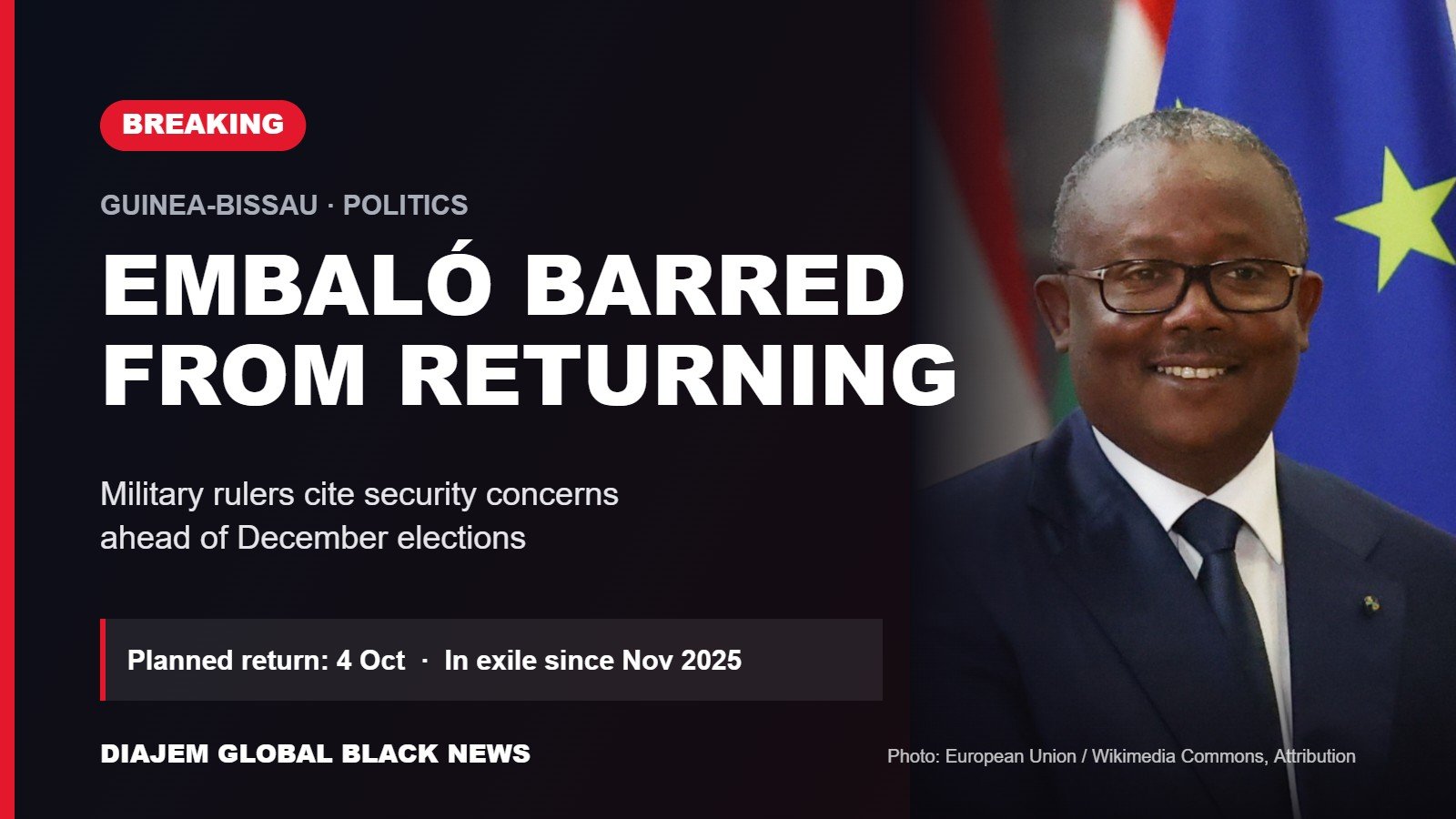
Guinea-Bissau’s military rulers have barred former president Umaro Sissoco Embaló from coming home, declaring that the security conditions for his return are not in place.
Main image: DGBN graphic. Photo: European Union / Wikimedia Commons, Attribution
Embaló, who led the West African nation from 2020 to 2025, had planned to fly back on Sunday 4 October and has said he intends to stand in elections expected in December.
Military cites security and public order
The ban was announced in a statement on Thursday after a meeting of the country’s military leadership. The statement said “the necessary security conditions” for Embaló’s return did not currently exist, and that the measure was needed to protect national security and public order, according to The Associated Press.
The military command did not set out what specific threat it believed his return would pose.
Embaló vows to stay in the race
Embaló has lived in exile in Morocco since army officers seized power in November 2025, after a disputed presidential election in which both he and the opposition candidate claimed victory.
Responding to the ban, he told supporters he would still contest the December vote, which is meant to restore civilian rule. He said he hoped the judicial authorities would review his candidacy impartially, independently and in line with the principles of justice.
A transition under scrutiny
The decision adds to questions over how open the coming election will be. In August, the military government held a referendum that approved sweeping constitutional changes, including expanded presidential powers and a smaller parliament.
Guinea-Bissau, a Portuguese-speaking country of about two million people, has a long history of coups and attempted coups since it won independence from Portugal in the 1970s.
Why it matters
Guinea-Bissau is one of several African states now run by soldiers after a wave of military takeovers in recent years, from Mali, Burkina Faso and Niger to Guinea and Gabon. The West African bloc ECOWAS has repeatedly pressed military governments in the region to hand power back to elected civilians.
Whether a former head of state can return and compete freely will be an early test of whether December’s vote offers Bissau-Guineans a genuine choice, and of how seriously the region’s promised transitions to civilian rule should be taken.