
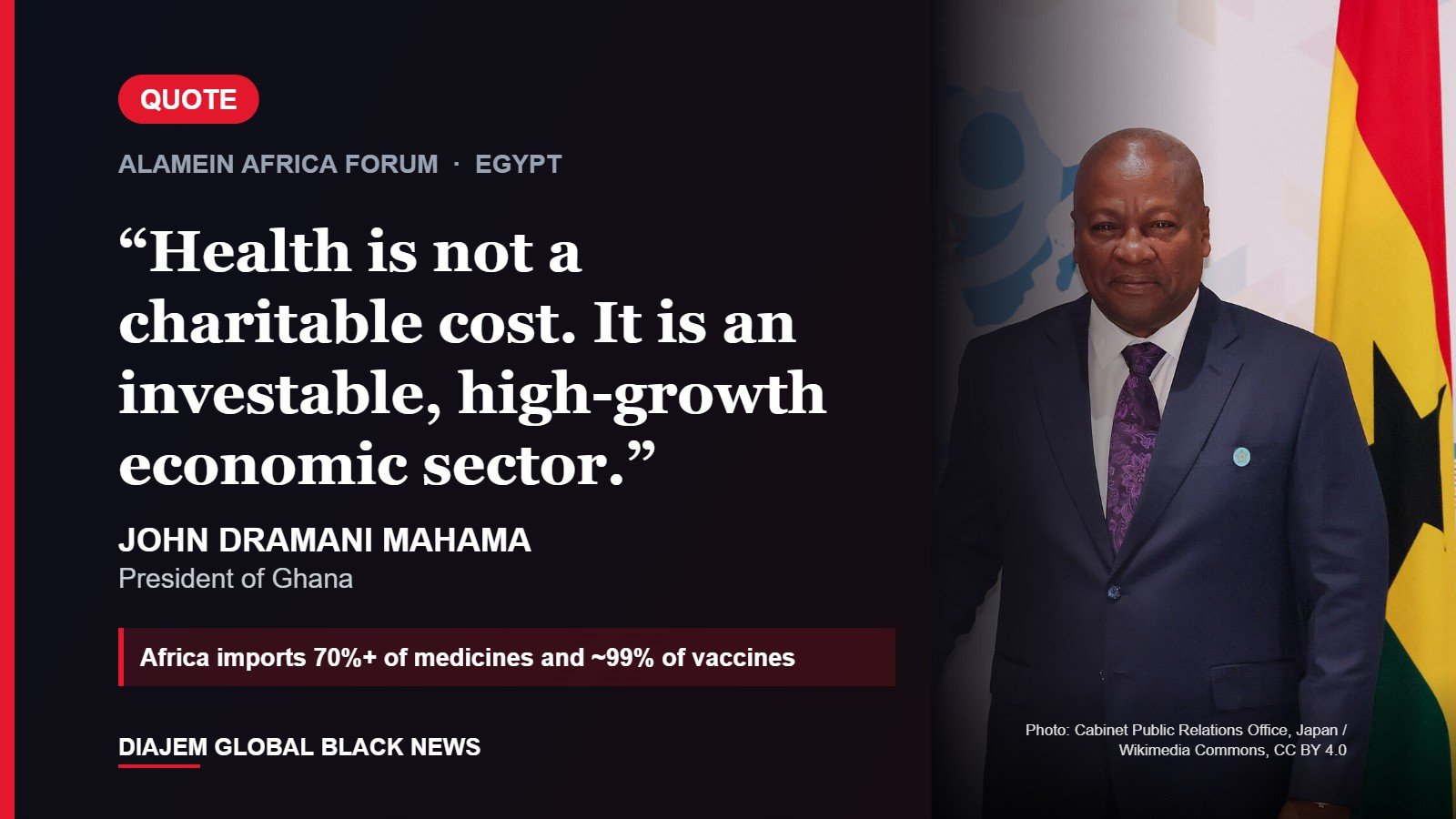
Ghana’s President John Dramani Mahama has told African leaders gathered in Egypt that the continent must stop treating health as a charity case and start treating it as an investment, setting “health sovereignty” for 1.4 billion Africans as the goal.
Main image: DGBN graphic. Photo: Cabinet Public Relations Office, Japan / Wikimedia Commons, CC BY 4.0
Speaking on Saturday at the Alamein Africa Forum in El Alamein, on Egypt’s Mediterranean coast, Mahama argued that money spent on health should be seen as capital for growth rather than a drain on national budgets. “Health is not a charitable cost. It is an investable, high-growth economic sector,” he said, according to Ghana’s Graphic Online.
The forum, which opened this weekend with around 1,500 delegates, runs alongside the African Union’s mid-year coordination summit, where heads of state are due to meet on Sunday.
The cost of importing medicine
Mahama built his case on the scale of Africa’s dependence on foreign supplies. He said the continent imports more than 70 per cent of its pharmaceuticals and almost 99 per cent of its vaccines, a pattern that drains billions of dollars in hard currency every year.
He also pointed to research suggesting that every dollar invested in basic maternal and newborn care returns about $87 in economic and social benefits. “The arithmetic is indisputable,” he told delegates.
With traditional donor support shrinking, he warned that Africa cannot wait for outside help. He cited OECD projections that health aid could fall by between 29 and 46 per cent compared with 2024 levels, and urged private investors to step in.
One market of 1.4 billion people
The Ghanaian leader said the African Continental Free Trade Area changes the business case for local drug and vaccine production. A factory built under the agreement, he argued, would not be serving one country of 10 or 30 million people but a single market of 1.4 billion consumers.
“Health sovereignty means health security for citizens, high-value jobs and affordability,” he said.
Mahama used the platform to present HINGE, the Health Investment and National Gateway Enabler, a digital platform developed with the African Medicines Agency and Institut Pasteur. It is designed to help innovators and investors move more quickly through regulation, clinical validation and commercialisation. He also praised Egypt’s hepatitis C elimination programme as proof of what African health systems can achieve.
Ghana’s own health push
At home, Mahama said his government is expanding the National Health Insurance Scheme, rolling out free primary healthcare, building up the Ghana Medical Trust Fund, known as MahamaCares, and strengthening the Food and Drugs Authority, with the aim of turning Ghana from a consumer of healthcare products into a producer.
Why it matters
The Covid-19 pandemic showed how far down the queue Africa sits when vaccines and medicines run short. For Africans at home and in the diaspora, the question of who makes the continent’s medicines is about more than trade: it decides how quickly families get treatment in the next crisis. Mahama’s pitch is that local manufacturing can protect lives and create skilled jobs at the same time.
Egypt has already said the gathering will become a regular biennial business forum. Whether Mahama’s call turns into new factories will depend on the investors in the room, and on the AU leaders meeting on Sunday.