
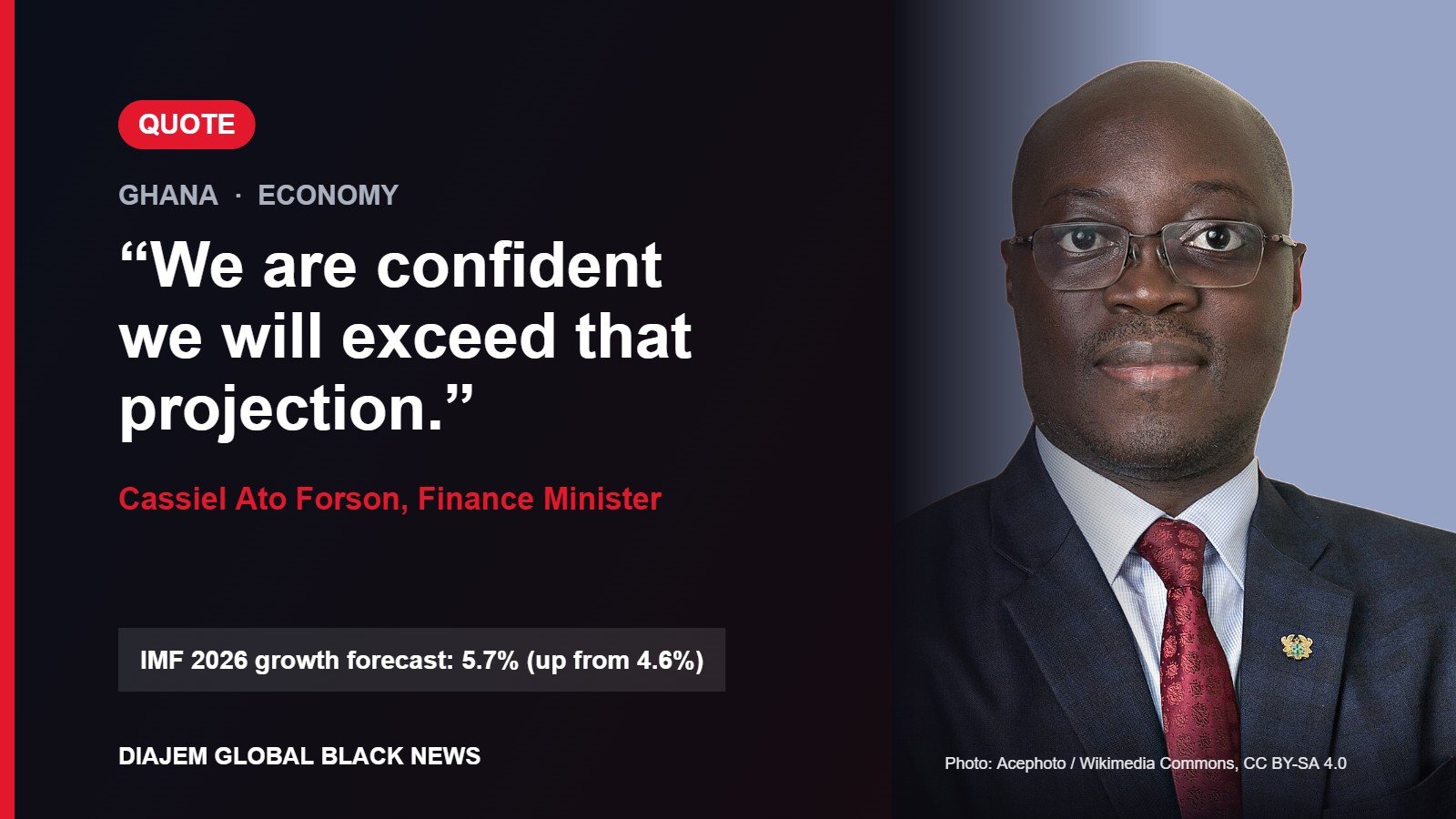
Ghana’s Finance Minister Cassiel Ato Forson says the economy will grow even faster than the International Monetary Fund now expects, days after the Fund sharply raised its forecast for the country.
Main image: DGBN graphic. Photo: Acephoto / Wikimedia Commons, CC BY-SA 4.0
A bigger number from the IMF
In its October World Economic Outlook, released on 13 October during the IMF and World Bank Annual Meetings in Bangkok, the Fund lifted its 2026 growth projection for Ghana to 5.7%, up from the 4.6% it pencilled in back in April. That is also comfortably above the government’s own budget target of 4.8%.
The IMF also cut its year-end inflation forecast for Ghana to 4.8%, from 7.9% in April. It expects growth to ease to 5.2% in 2027, suggesting the current pace may not be fully sustained.
“We will exceed that projection”
Speaking after talks with Zeine Zeidane, Director of the IMF’s African Department, on the sidelines of the Bangkok meetings, Ato Forson struck a bullish note. “We are confident we will exceed that projection,” he said, according to Citi Newsroom.
He said he had used the meeting to restate the government’s commitment to fiscal credibility, discipline and reform, which he credits for what he calls Ghana’s economic turnaround. Official data give him some cover: the Ghana Statistical Service recorded growth of 6.2% for the first half of 2026.
Central bank wants every export dollar home
Behind the upbeat headline numbers, the Bank of Ghana is pressing exporters to play their part in keeping the cedi stable. At a stakeholder meeting on revised Letters of Commitment guidelines, Second Deputy Governor Matilda Asante-Asiedu urged exporters to bring all their earnings back through the formal banking system.
“Every dollar of exports that fails to come to Ghana has many implications,” she said, warning that unreturned proceeds weaken reserves and limit the country’s ability to pay for imports and absorb shocks. She noted that Ghana’s oil import bill had risen by nearly 40% amid geopolitical tensions.
The Ministry of Finance has added teeth. Victor Kofi Baidoo, its head of revenue assurance, said amendments to the Customs Act mean an export declaration without repatriated proceeds will not count as an export, exposing traders to duties, taxes and other sanctions.
Why it matters
Only a few years ago Ghana was negotiating a $3 billion IMF bailout after defaulting on most of its external debt. A forecast upgrade of this size, alongside single-digit inflation, marks one of the sharper recoveries on the continent and is being watched closely by investors, neighbours and Ghanaians abroad.
For the diaspora, a steadier cedi and lower inflation mean remittances stretch further and investment at home carries less risk. The real test, as the IMF’s more cautious 2027 figure hints, is whether Accra can keep the momentum going.