
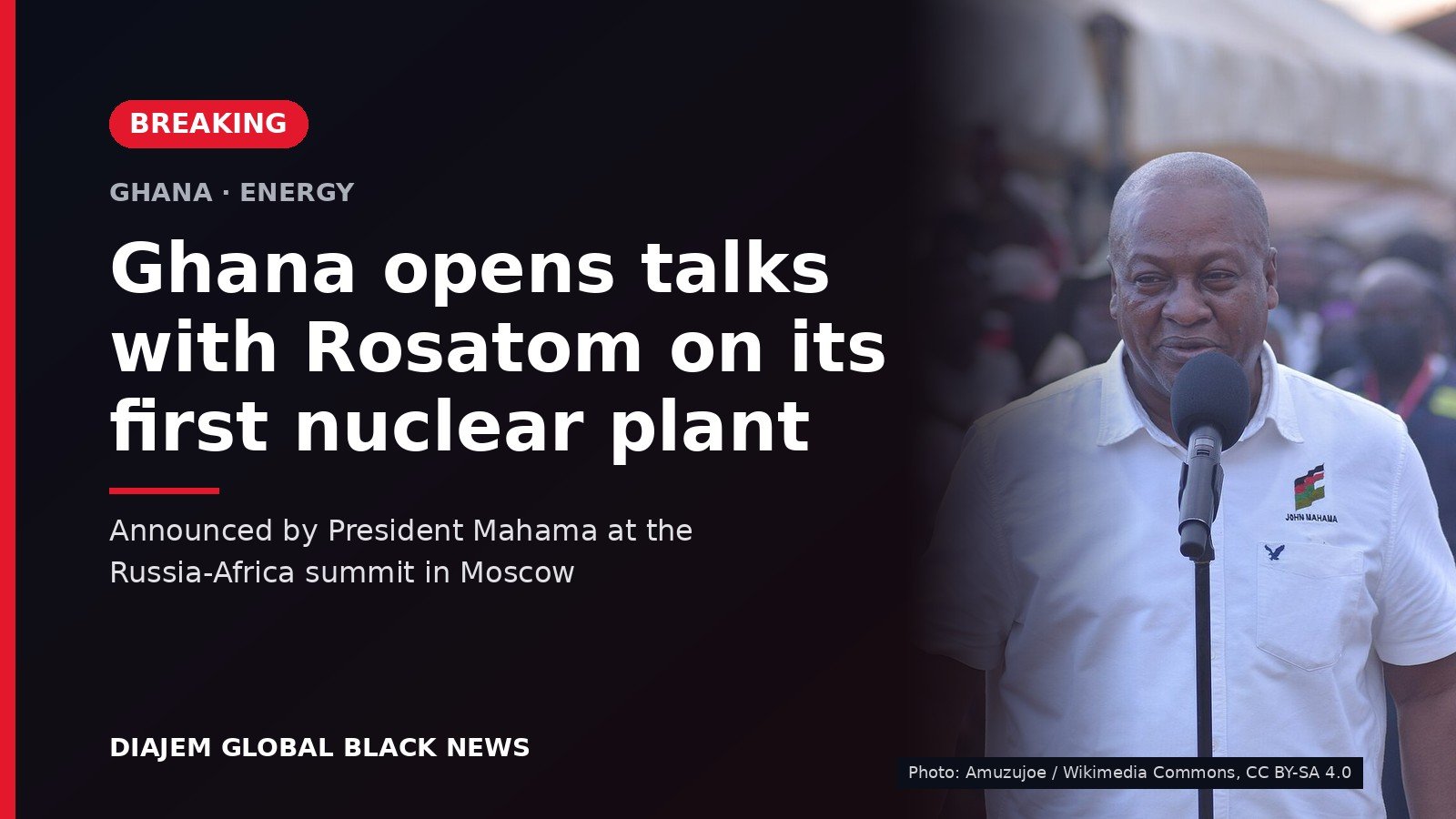
Ghana has formally begun talks with Russia’s state nuclear corporation, Rosatom, on building the country’s first nuclear power station, President John Dramani Mahama has announced.
Main image: DGBN graphic. Photo: Amuzujoe / Wikimedia Commons, CC BY-SA 4.0
Mahama made the disclosure in Moscow at the third Russia-Africa summit, where he argued that unreliable electricity remains one of the biggest brakes on the continent’s progress.
“We have initiated discussions with Rosatom on the establishment of Ghana’s first nuclear power station,” the President told the gathering, according to Ghanaian media reports of his address.
Power as the price of industrialisation
Mahama’s case was simple: no country industrialises without electricity that is both dependable and affordable. He presented nuclear energy, alongside renewables, as an area where Russia holds a clear advantage and where cooperation with Africa could deliver concrete results.
A nuclear plant would give Ghana steady baseload supply to sit alongside its existing hydropower and thermal stations, at a time when demand is climbing with population growth and new industry.
No timeline, cost estimate or site has been announced. Talks of this kind are an early step, and nuclear projects typically take many years of regulatory, financial and technical preparation before construction begins.
A link that goes back to 1964
The President reminded his audience that Ghana’s nuclear ties with Moscow are not new. In 1964, under Kwame Nkrumah, the Soviet Union supplied Ghana with a two-megawatt research reactor, and a number of Ghanaian nuclear scientists were trained in Russia to run it.
That history gives Accra’s ambition some depth. Ghana has spent years building the legal and institutional groundwork for nuclear power, and the Rosatom talks mark the clearest public signal yet that the government wants to move from planning to partnership.
Why it matters
Energy poverty sits at the heart of Africa’s development story. Hundreds of millions of Africans still lack reliable power, and frequent outages drive up costs for businesses from Accra to Lagos. If Ghana does build a nuclear plant, it would join a very small club on the continent, and other West African states will be watching closely.
The announcement also fits a wider pattern at this week’s summit, where African leaders have pressed Moscow for factories, technology and investment rather than aid. DGBN has covered how the Russia-Africa summit shifted its focus from diplomacy to delivery, and Mahama’s wider push to revive national assets, including his pledge to get Ghana Airways flying again.
Critics of nuclear power across the region often raise questions about cost, debt, waste management and safety oversight. How Ghana answers those questions, and on what financial terms any Rosatom deal is struck, will decide whether this ambition becomes reality.