
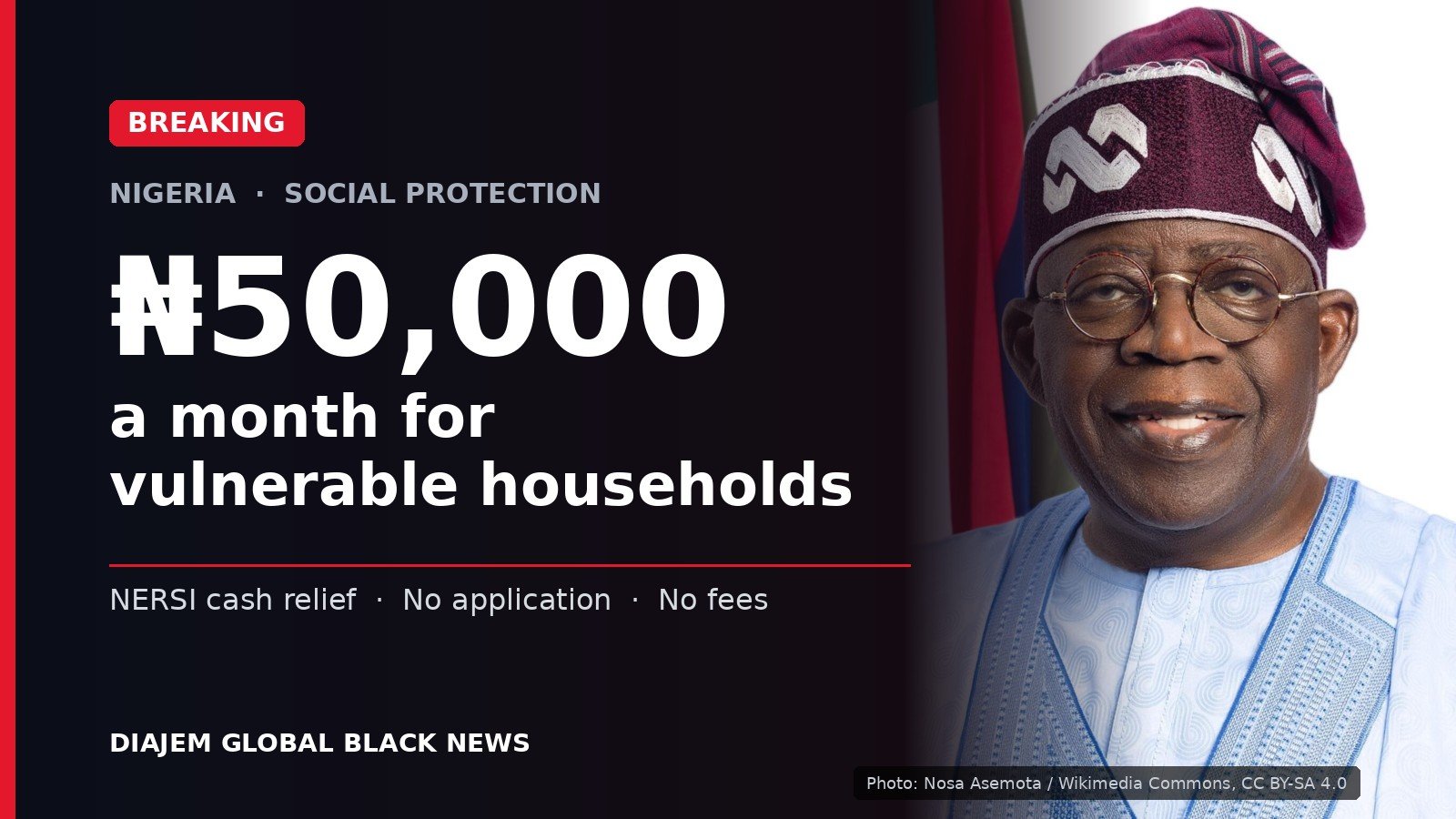
Nigeria’s federal government has begun paying ₦50,000 a month directly to vulnerable households, launching a new presidential cash relief scheme aimed squarely at the soaring cost of food and everyday essentials.
Main image: DGBN graphic. Photo: Nosa Asemota / Wikimedia Commons, CC BY-SA 4.0
The programme, called the National Emergency Relief and Stabilisation Intervention (NERSI), was announced on Friday in Abuja by the Minister of Humanitarian Affairs and Poverty Reduction, Bernard Doro. He described it as a presidential initiative designed to give immediate financial support to millions of Nigerians under pressure.
How the payments will work
According to the minister, eligible beneficiaries will receive ₦50,000 every month. The ministry says it is working with licensed digital financial service providers to move the money securely and on time.
Before any payment lands, beneficiaries will receive a text message from a service provider asking for their consent. The money will then be paid straight into their bank account or mobile wallet.
Doro said the amount will be reviewed from time to time to keep pace with the cost of living, and that recipients will be told directly before any change is made.
No forms, no fees, no agents
The minister was emphatic that nobody needs to apply, pay a fee or register through an agent to receive the money. He warned Nigerians to guard against fraudsters and never to share their PIN or Bank Verification Number (BVN) with anyone.
Anyone unsure about a message, or approached for money, has been urged to call the official NERSI helpline on 0700-022-2222.
Why it matters
The government says the scheme responds to global food inflation and the rising price of basic goods, which have squeezed household budgets across Africa’s most populous country. It comes as the cost of living dominates Nigerian politics, from fuel prices to food, with organised labour pressing the government for relief. DGBN has reported on that pressure, including when labour gave the Tinubu government two weeks to cut petrol prices.
Doro described NERSI as a complement to existing federal social protection and economic support programmes, intended to strengthen household resilience and promote economic stability. He tied it to President Bola Tinubu’s Renewed Hope Agenda and pledged that it would be run with dignity, transparency and accountability.
For Nigerians at home and in the diaspora, many of whom send money back to support relatives, the scheme’s real test will be reach and reliability. The minister’s statement did not say how many households will benefit or how they were selected. How quickly the money arrives, and whether it reaches those who need it most, will decide whether NERSI truly eases the squeeze.