
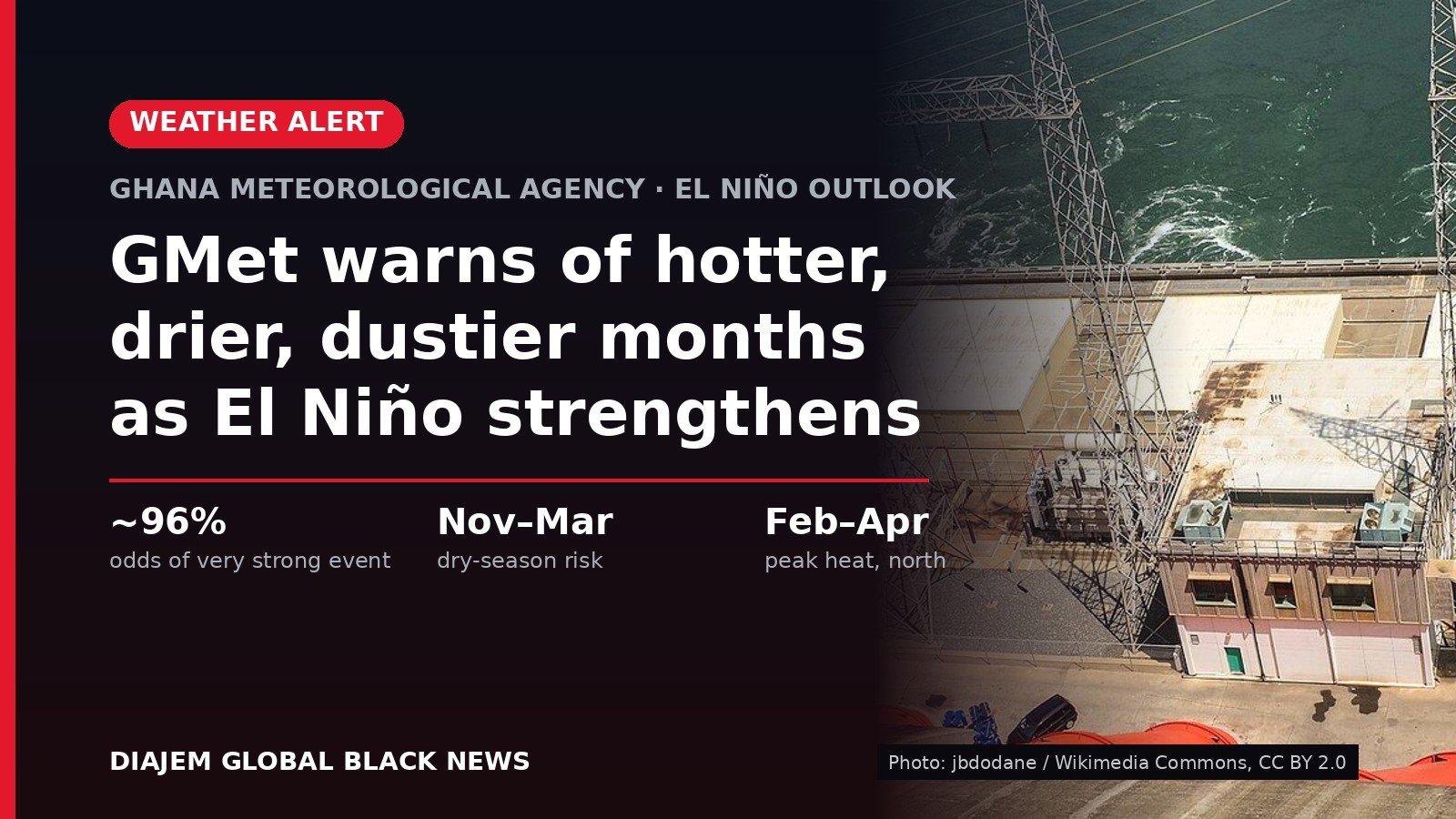
Ghana’s weather agency has put the country on notice: a very strong El Niño building in the Pacific is likely to bring a hotter, drier and dustier dry season, with knock-on risks for farms, water supplies, electricity and public health well into 2027.
Main image: DGBN graphic. Photo: jbdodane / Wikimedia Commons, CC BY 2.0
The Ghana Meteorological Agency (GMet) said on Sunday that monitoring by its own systems and by international bodies, including the US National Oceanic and Atmospheric Administration and the World Meteorological Organization, shows the event is still intensifying.
According to a GMet technical brief revised after scientific review on 27 October and reported by the Daily Graphic, there is about a 96 per cent chance that El Niño reaches “very strong” intensity in the November 2026 to January 2027 window. It is expected to peak around now and then weaken gradually during the first half of next year.
What Ghanaians can expect
GMet forecasts below-normal rainfall across most of the country, with warmer-than-average temperatures. A few pockets may see above-normal rain, including inland Greater Accra and Central regions, parts of the Volta and Eastern regions, parts of Bono and Savannah, and the north-west of Upper West.
The dry season, expected from late November to March, is likely to be drier and dustier in many areas. That raises the risk of bushfires, water shortages and stress on crops and livestock. Heat stress is forecast to peak between February and April 2027, especially in the north.
The agency also warned that hot, dusty conditions could raise the seasonal risk of meningitis in northern Ghana, and urged anyone with fever, severe headache or a stiff neck to seek medical help quickly.
Floods are not off the table
Drier on average does not mean dry everywhere. GMet cautioned that short, intense downpours and localised flooding remain possible, particularly in southern Ghana, and told communities along the Volta River and in low-lying urban areas to keep following advice from NADMO and the Volta River Authority.
Power, cocoa and food prices
Ghana has been here before. The very strong El Niño events of 1982/83, 1997/98 and 2015/16 hit harvests, water supplies and hydropower. GMet says electricity generation this dry season will rely mainly on water already stored in Lake Volta behind the Akosombo Dam; the bigger worry is the 2027 inflow season, which will shape power output in 2028.
Rain-fed farming, cocoa, water management in the Volta basin and dry-season public health are named as the most exposed sectors. GMet has recommended a National El Niño Preparedness Task Force, closer real-time monitoring of Volta Lake levels, pre-positioned drought-tolerant seed and heat-health action plans.
Farmers are advised to follow GMet and Ministry of Food and Agriculture bulletins before planting, consider early-maturing and drought-tolerant varieties, and avoid bush burning. Households are urged to conserve water, drink plenty during hot spells and check on older people and young children.
Why it matters
Ghana is the world’s second-largest cocoa producer, so a poor season reaches chocolate prices far beyond West Africa. For Ghanaians abroad, a squeeze on food, water and power at home often means more pressure on remittances. And with Accra already exploring new energy sources, including talks on its first nuclear power plant, the forecast is a fresh reminder of how much the country still leans on the Volta.