
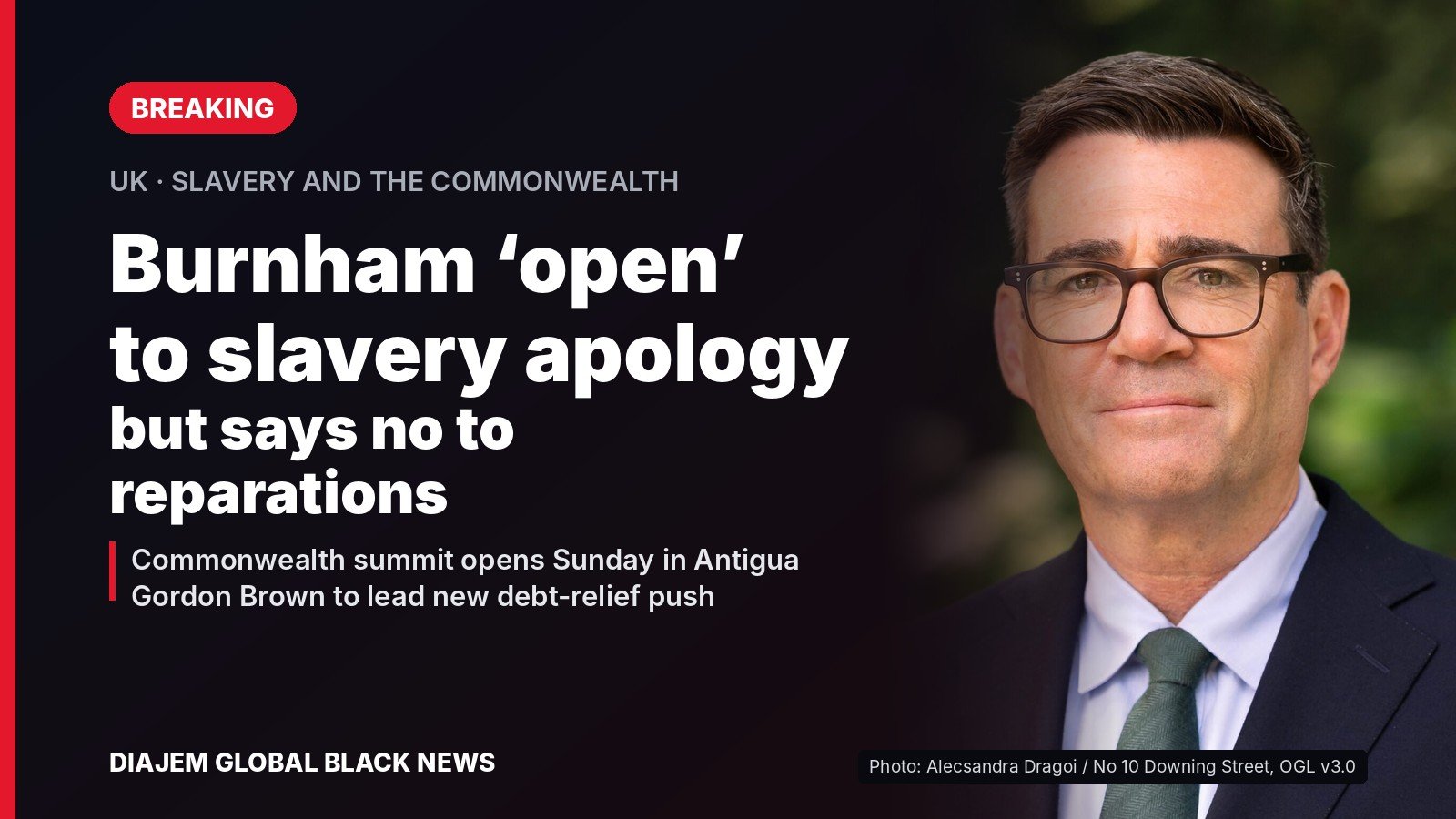
UK Prime Minister Andy Burnham has opened the door to Britain’s first formal apology for its role in the transatlantic slave trade, but has firmly shut it on financial reparations.
Main image: DGBN graphic. Photo: Alecsandra Dragoi / No 10 Downing Street via Wikimedia Commons, OGL v3.0
Writing in The Guardian ahead of the Commonwealth Heads of Government Meeting (CHOGM) in Antigua and Barbuda, Burnham said Britain needed to “face up to the past” and offered a “structured dialogue” with countries and communities affected by slavery.
“Listening to calls for a formal apology on behalf of the British state will form an important part of this process and I am open to them,” he wrote, expressing his “sorrow and regret” for the suffering of millions of enslaved Africans.
A firm no on reparations
The prime minister drew a hard line on money. “I do not think that British people today can be held liable for historical wrongs, however heinous, that happened in a different age under different laws and in which they played no personal part,” he wrote, describing the trade itself as a “brutal and barbaric violation” of human rights.
Instead, Burnham is pitching a new push to ease the debt burden on the poorest Commonwealth nations, with longer repayment periods and lower interest rates. Former prime minister Gordon Brown, a long-standing champion of debt relief, will attend the summit to help drive the initiative.
Caribbean leaders respond
Barbados Prime Minister Mia Mottley welcomed the opening for talks while restating her government’s position on reparations, according to Al Jazeera, citing a statement reported by The Guardian. Antigua and Barbuda’s Prime Minister Gaston Browne, who hosts the summit, welcomed the debt initiative.
Campaigners were less patient. Denis O’Brien, founder of The Repair Campaign, told AFP that London “must stop obfuscating and give a full and formal apology now”. CARICOM’s 10-point reparations plan goes well beyond an apology, calling for support for health, education and economic repair.
At home, Conservative leader Kemi Badenoch said there was “no need” to revisit an apology and repeated her opposition to reparations, writing on X that the Commonwealth should “look forward” and “not endlessly backwards”.
The King arrives in Antigua
King Charles III has now arrived in Antigua and Barbuda after a state visit to Guyana, where he visited Independence Park in Georgetown, the site where 33 people involved in the 1823 Demerara Rebellion were hanged. Earlier in the Bahamas he acknowledged “the great suffering of the past” but stopped short of an apology, in line with government policy. He opens the summit on Tuesday, and PA Media reports his speech is likely to reflect Downing Street’s shift.
Why it matters
Britain has never formally apologised for slavery. For Caribbean nations, African states and the Black diaspora in the UK, an official apology from the British state would be a historic first step, but many will see an apology without repair as only half the answer. The debate now moves to St John’s, where the summit runs from Sunday to Wednesday.
Read more: UN committee presents legal case for broad slavery reparations and Ghana leads the demand for slavery reparations.