
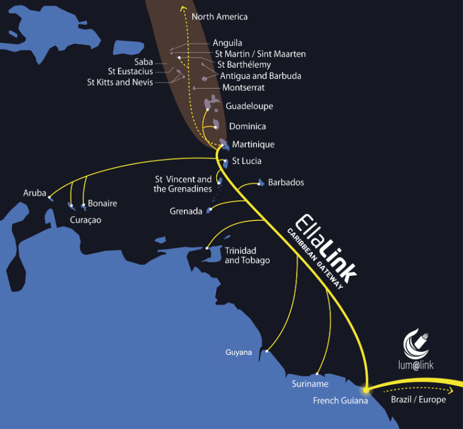
EllaLink has formally launched the development phase of a new submarine cable initiative designed to strengthen international connectivity across the Caribbean and the Guianas.
The planned EllaLink Caribbean Gateway would run from Cayenne in French Guiana north through the Caribbean, with connections planned for Suriname, Guyana, Trinidad and Tobago, Barbados, St Vincent and the Grenadines, Grenada, St Lucia, Martinique, Dominica and Guadeloupe. A western segment is also planned toward Aruba, Curaçao and Bonaire.
The project is designed to provide more direct digital routes from participating territories toward Europe through EllaLink’s existing transatlantic system, toward Brazil through Fortaleza, and onward to North America.
A development project, not a completed cable
The distinction is important. EllaLink has launched the development phase; the new Caribbean system is not yet in service.
The company says the next stage involves turning letters of intent into firm commitments with landing partners, completing the financing structure and finalising the arrangements required before construction can begin. The current target is for the system to be ready for service by the end of 2029.
EllaLink describes the project as an open, carrier-neutral network. Its model allows individual landing parties to own their branches and determine how capacity is allocated and commercialised locally.
Why submarine cables matter to the Caribbean
Most international internet traffic moves through fibre-optic cables laid across the seabed. Those cables underpin cloud services, streaming, financial technology, digital government, online education, remote work, tourism platforms and increasingly data-intensive artificial intelligence services.
For island economies, the number and diversity of international routes can also affect resilience. A territory that depends heavily on a limited number of routes can face greater disruption when a cable is damaged or a landing point fails.
EllaLink says some cable systems serving the wider region are expected to phase out during the next decade, while traffic demand continues to rise. A newer route could therefore add both capacity and route diversity if the project reaches construction and service.
The economic question for the region
Better international connectivity does not automatically reduce consumer prices or guarantee local technology investment. Those outcomes depend on landing arrangements, wholesale competition, domestic fibre networks, regulation, cloud infrastructure and how local operators purchase and distribute capacity.
But the project could become significant for countries seeking to expand data centres, digital financial services, cloud computing, AI applications and cross-border technology businesses.
It also creates an important policy question for Caribbean governments: how should new international capacity be structured so that local businesses, public services and consumers benefit from the investment rather than simply adding another route on a network map?
DGBN will track the financing, landing agreements and construction milestones as the Caribbean Gateway moves through development.
Source: EllaLink Ireland Limited, 29 September 2026. Official project announcement.