
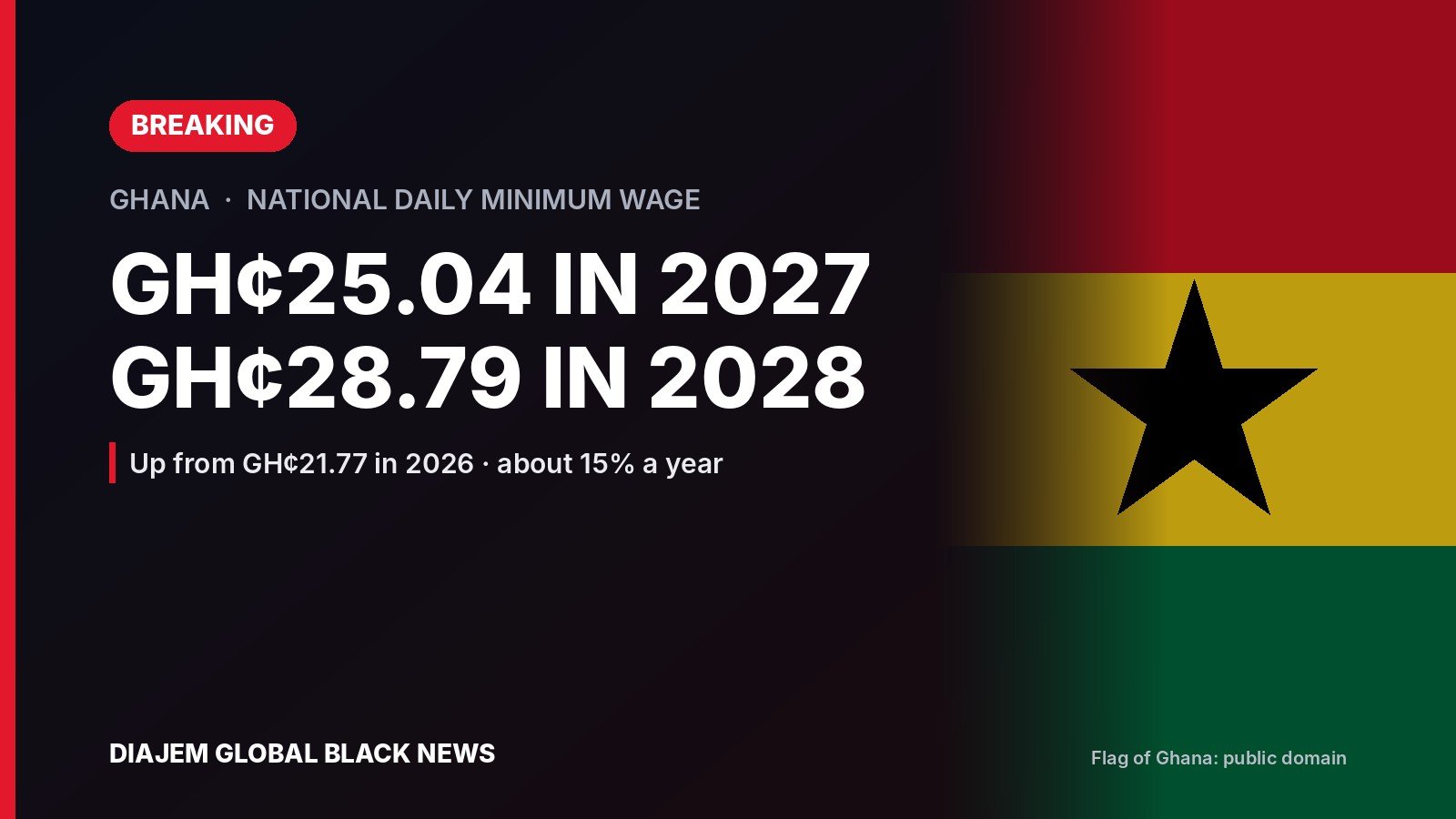
Ghanaian workers on the lowest pay will earn GH¢25.04 a day from January 2027 and GH¢28.79 from January 2028, after government, employers and unions agreed a two-year minimum wage deal on Tuesday.
Main image: DGBN graphic. Flag of Ghana: Wikimedia Commons, public domain
The new rates were set out in a communiqué from the National Tripartite Committee (NTC), dated 10 November 2026, following negotiations between the state, the Ghana Employers’ Association and organised labour.
The current national daily minimum wage is GH¢21.77, set for 2026 after a 9% increase last year. The 2027 figure therefore represents a rise of roughly 15%, and the 2028 rate adds close to another 15% on top.
A first two-year framework
Rather than haggling year by year, the committee adopted a two-year negotiating framework. According to the communiqué, the aim is to give workers and businesses more predictability and to support medium-term budgeting.
The deal is not locked in stone. The NTC said it may reconvene early if inflation, exchange rates or economic growth shift materially, with any change to be agreed by consensus among the three parties.
Employers currently paying below the new floor must adjust their pay from 1 January 2027. The committee urged full compliance and called on government to make the national daily minimum wage exempt from tax.
Who signed
The agreement was signed by Labour, Jobs and Employment Minister Emmanuel Kwadwo Agyekum; Deputy Finance Minister Thomas Nyarko Ampem; Ghana Employers’ Association President Nana Dr Emmanuel Adu-Sarkodee Afrifie; and Trades Union Congress Secretary-General Joshua Ansah.
The announcement lands two days before Finance Minister Cassiel Ato Forson presents the 2027 Budget to Parliament on Thursday, 12 November. It also follows months of government messaging about falling inflation and a steadier cedi, which unions have long argued must translate into real gains on the payslip. DGBN has previously reported on Ato Forson’s pledge to beat the IMF’s 5.7% growth forecast.
Why it matters
Ghana’s minimum wage is a benchmark well beyond the lowest-paid. It shapes pay talks across the private sector, informs allowances and is closely watched by families in the diaspora who send money home to cover the gap between wages and living costs.
A multi-year deal with a built-in review clause is a test of whether Ghana’s economic recovery can be shared with ordinary workers. If inflation keeps easing, a 15% rise would mean a genuine increase in purchasing power. If prices surge again, the early-review clause will quickly come under pressure from labour.