
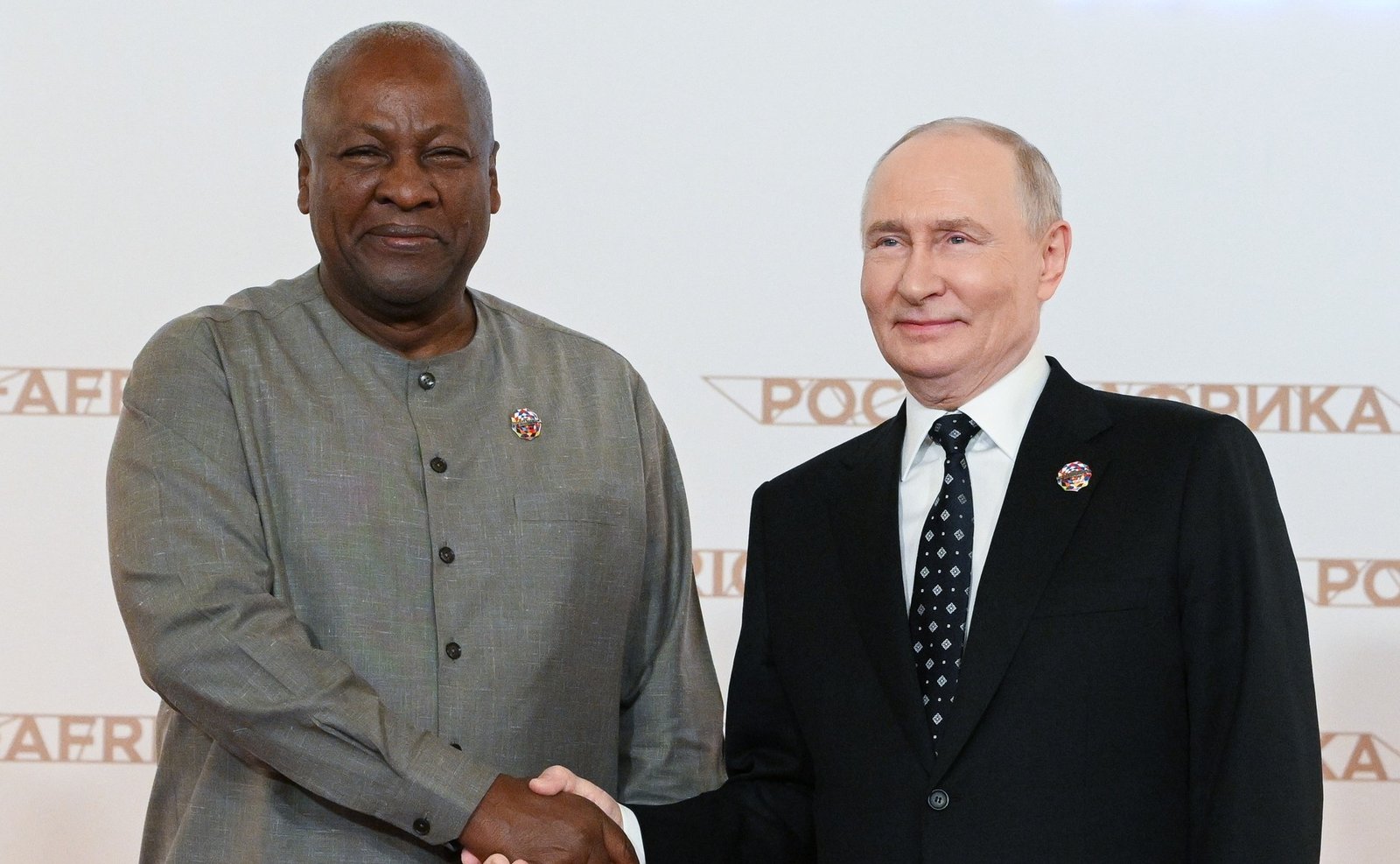
Ghana has walked away from the Russia-Africa Summit with a new defence pact, Russian backing for a 2,000-megawatt nuclear power plant and a pledge from Vladimir Putin that Ghanaians will no longer be drawn into the war in Ukraine.
Main photo: Russian Presidential Executive Office (kremlin.ru) / Wikimedia Commons, CC BY 4.0
Foreign Minister Samuel Okudzeto Ablakwa set out the outcomes on Saturday, a day after President John Dramani Mahama held direct talks with the Russian leader in Moscow on 30 October. In a statement shared on X, Ablakwa listed six commitments that, if delivered, would reshape Accra’s relationship with Moscow.
Nuclear power and a defence pact
At the top of the list is nuclear energy. According to Ablakwa, Russia will work with Ghana to develop a 2,000MW nuclear power plant aimed at “strengthening energy security and industrialization”. He framed the project as a revival of Kwame Nkrumah’s original vision for nuclear power in Ghana.
The announcement follows confirmation from Russia’s state nuclear corporation, Rosatom, that it is in talks with four African countries, Ghana among them, on large-scale nuclear projects. DGBN reported earlier this week that Ghana had opened talks with Rosatom on its first nuclear power plant.
The two governments also agreed a new defence pact under which, Ablakwa said, Russia will supply the Ghana Armed Forces with strategic military assets. No figures, timelines or specific equipment have been made public.
An end to recruitment for the Ukraine war
The most emotive commitment concerns young Ghanaians who have ended up on the front line in Ukraine. Mahama raised the issue directly with Putin, and according to Ablakwa the Russian president agreed that Ghanaians will no longer take part in the war, whether through irregular recruitment or voluntary enlistment.
The scale of the problem has grown sharply. Ablakwa said in February, citing Ukrainian authorities, that about 272 Ghanaians were believed to have been lured into the conflict. In August he put the number killed at 62, with 15 more missing. At that time, Russian Foreign Minister Sergey Lavrov argued that Ghanaians had signed contracts with Russia’s Defence Ministry out of solidarity and for material and financial reasons.
Grain, scholarships and a revived commission
The package also covers agricultural cooperation on grain production and fertiliser, more scholarships for Ghanaian students in Russia, and the revival of the Permanent Joint Commission for Cooperation, which Moscow is reportedly ready to host within weeks.
The details so far come from Accra, and Moscow has yet to set out its own account of the agreements. For Mahama, who told Putin it was time to turn ties into trade and investment, the test now is delivery.
Why it matters
Reliable power is the foundation of any serious industrial plan, and a 2,000MW plant would be a major addition to Ghana’s grid. But the deal also places Ghana more firmly in the contest for influence across Africa, as the Russia-Africa summit shifts from diplomacy to delivery. For families who have lost sons in a distant war, the recruitment pledge may matter most of all, and Ghanaians will be watching closely to see whether it holds.