
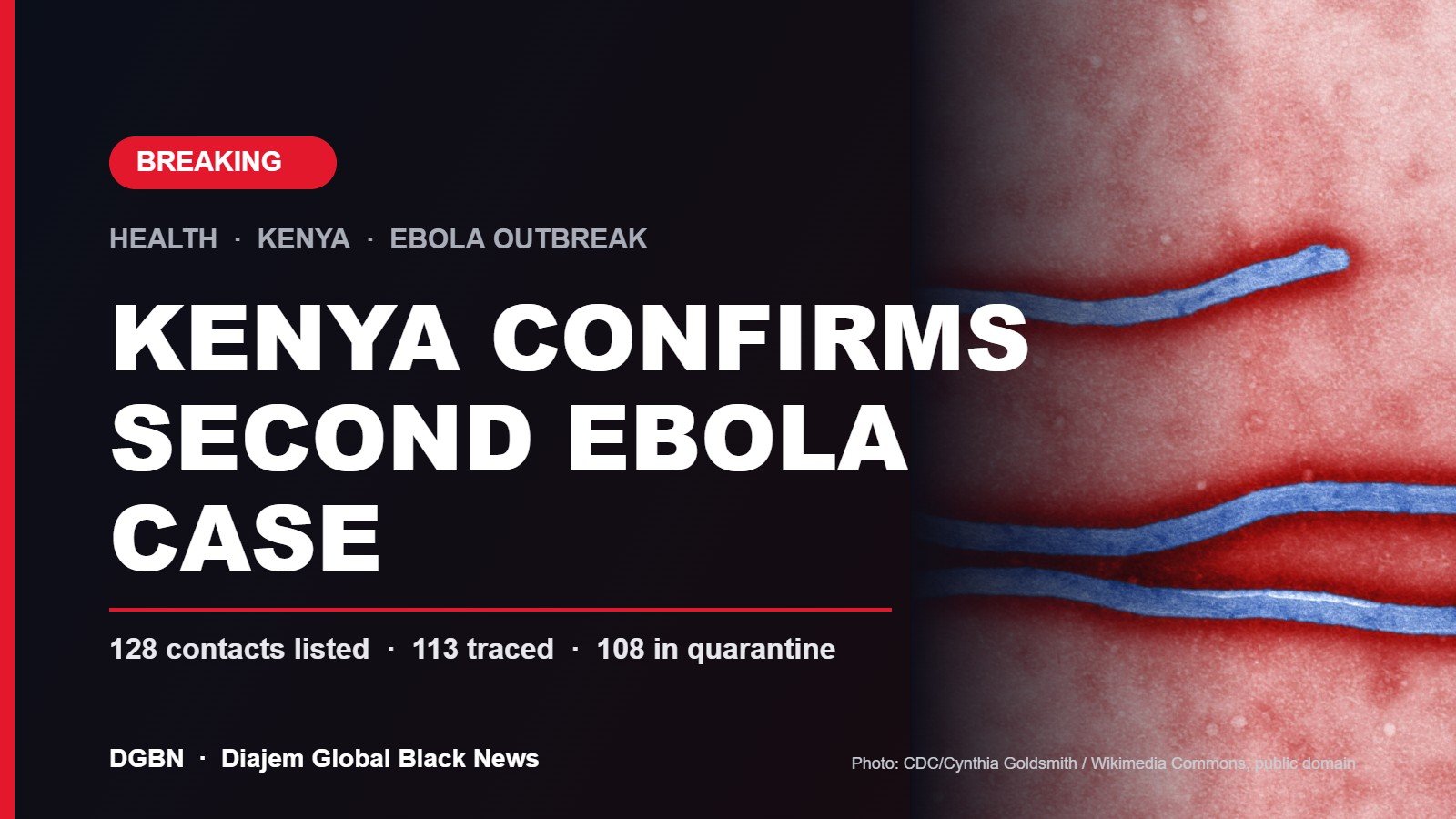
Kenya has confirmed its second case of Ebola, a relative of the country’s first patient who was already in quarantine when he fell ill, and the World Health Organization says the swift detection shows the country’s tracing system is working.
Main image: DGBN graphic. Photo: CDC/Cynthia Goldsmith / Wikimedia Commons, public domain
The Ministry of Health announced on Wednesday that a 39-year-old man, a close family member of the first case, had tested positive. He developed fever, fatigue and joint pains on Tuesday while under quarantine, was isolated immediately and is now receiving supportive care at a designated treatment centre.
The ministry said there was “no evidence of spread in the wider community”, stressing that catching the infection early limits the chance of the virus being passed on.
How the virus reached Nairobi
Kenya had never recorded an Ebola case before this month. Health Cabinet Secretary Aden Duale has said the first patient, a 40-year-old Kenyan businessman, had been treated in the Democratic Republic of the Congo, travelled through the Ugandan capital Kampala and flew into Nairobi on 3 October. He died two days later.
Officials have listed 128 contacts of that first patient. As of Tuesday, 113 had been traced: 108 are in quarantine in Kenya with daily checks for 21 days, and five are abroad, where the relevant authorities have been notified. The remaining 15 are still being sought. Kenya has not imposed restrictions on travel, trade or public gatherings.
How the first patient crossed three countries undetected remains under investigation, with Kenyan health chiefs planning talks with officials from the DRC, Uganda and the Africa CDC. Uganda’s government media centre has publicly objected to the country being linked to Kenya’s cases, according to Al Jazeera.
WHO: “surveillance and contact tracing efforts are working”
WHO Director-General Dr Tedros Adhanom Ghebreyesus welcomed Kenya’s response, saying “surveillance and contact tracing efforts are working”. He confirmed the case was caused by the Bundibugyo virus and said the WHO has been helping Kenya and its neighbours prepare for imported cases since the DRC outbreak began in May, covering surveillance, contact tracing and clinical care.
Why it matters
The Bundibugyo strain has no approved vaccine or specific treatment. The DRC’s outbreak, its 17th, has now recorded more than 9,000 infections and over 4,300 deaths according to Congolese authorities, making it one of the largest Ebola epidemics on record. DGBN has tracked its growth, including when the outbreak became the deadliest in the DRC’s history.
Kenya is East Africa’s main air and trade hub, and Nairobi links the region to Europe, the Gulf and beyond, so how quickly it contains these cases matters well outside its borders, including for diaspora families planning travel home. For now, the message from Nairobi and Geneva is cautious confidence: both cases are linked, and the second was caught inside the quarantine net.