
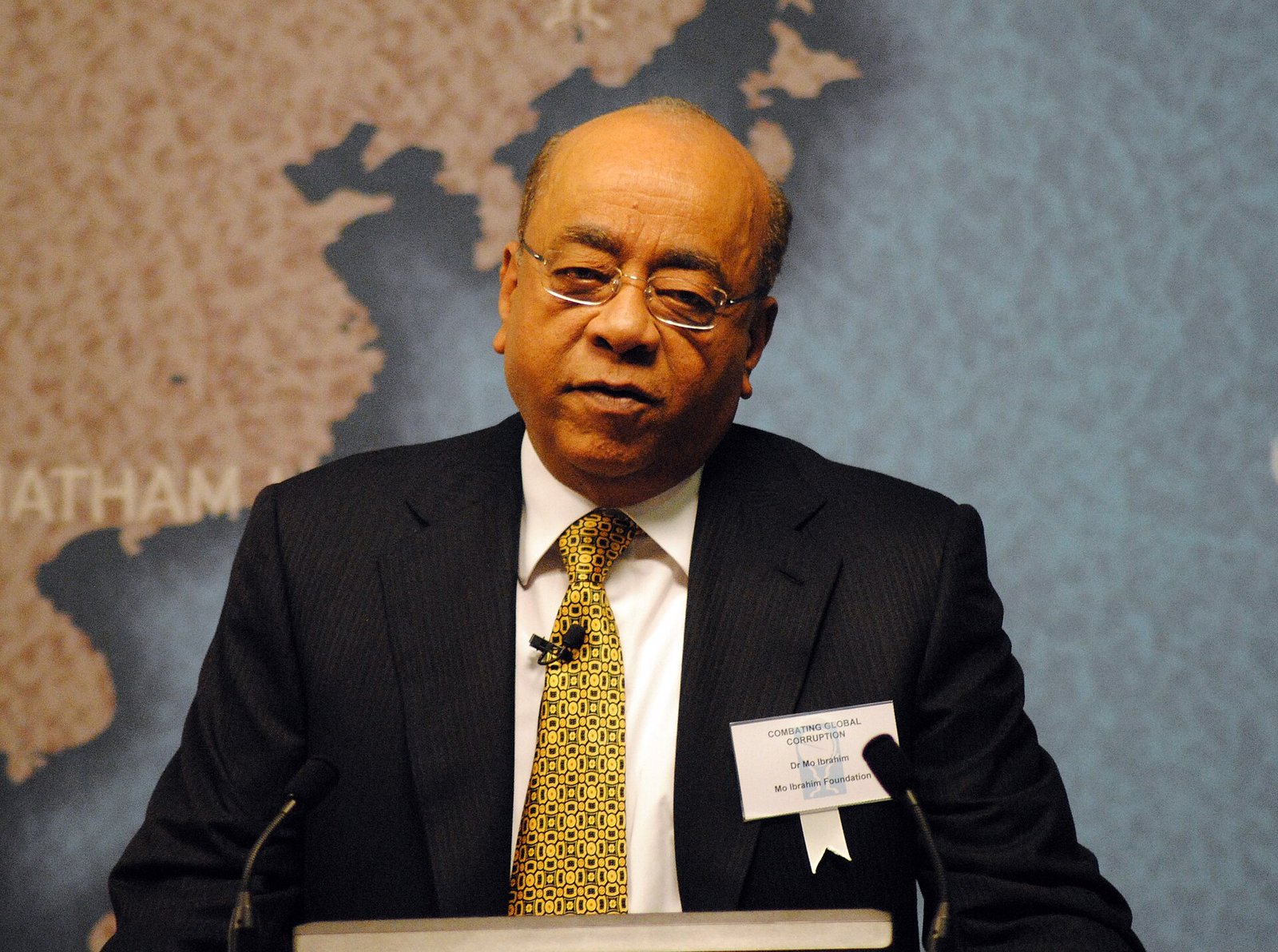
Mo Ibrahim, the Sudanese-British telecoms billionaire who has spent two decades grading how Africa is governed, says the continent’s leaders are taking their cue from a global wave of strongmen – and his latest index shows the damage.
Main photo: Chatham House / Wikimedia Commons, CC BY 2.0
Speaking to AFP on Sunday, a day after his foundation published the 2026 Ibrahim Index of African Governance (IIAG), the 80-year-old said democracy and rights were retreating across Africa as leaders watched authoritarian politics gain ground elsewhere.
“It is a strange era… we can see this phenomenon of the rise of strongmen everywhere,” he said. “If you’re an African leader and you see all those strong people rising everywhere… you say, why not me too? I can get away with it.”
What the 2026 index found
The index, released on 31 October at an event in Cairo, covers all 54 African countries over the decade 2016–2025. Overall governance improved slightly, with the continental average edging up from 49.3 to 50.1 out of 100, according to the foundation’s figures.
Thirty countries, home to roughly half of Africa’s people, scored better in 2025 than in 2016. But 23 countries went backwards and one was unchanged.
All of the gains came from the economy and human development. Infrastructure improved in 52 of 54 countries – every one except Nigeria and The Gambia – driven by mobile connectivity, electricity and internet access. Health and education also moved forward in most of the continent.
The other side of the ledger is stark. Security and the rule of law declined in 34 countries, and participation, rights and inclusion fell in 31. The foundation’s own warning is blunt: economic progress without security and accountability “is not a sustainable trade-off”.
Winners, losers and Nigeria’s slide
Seychelles tops the table, followed by Mauritius, Cabo Verde, Botswana and South Africa, with Namibia, Morocco, Senegal, Ghana and Kenya completing the top ten. Morocco replaces Tunisia in that group. South Africa holds fifth place but is flagged for “increasing deterioration”.
Burkina Faso recorded the steepest fall of the decade. Nigeria, Africa’s most populous nation, posted the second-largest decline, dropping 5.2 points to 44.2 and sitting 38th. Seven of the ten biggest decliners experienced at least one coup over the period. Nigeria, DR Congo, South Africa and Sudan – four of the continent’s largest countries – all deteriorated overall.
Ibrahim pointed to recent elections in Tanzania and Uganda as examples of the trend, describing what happened there as “disgraceful”.
Aid cuts and self-reliance
Ibrahim also criticised what he called Washington’s more “transactional” diplomacy, saying it was weakening the international order. He described the abrupt shutdown of USAID last year as “brutal”, adding: “Of course, it is a prerogative of US to give aid or not. But please give notice.”
The cuts, he argued, have forced Africa to face reality. “We need to depend more on ourselves,” he said, urging the continent to work with any partner willing to engage, whether Europe, China, India or others. The debate echoes calls made by African civil society for an Africa-led model to replace a broken aid system, and comes days after leaders courted new partners at the Russia-Africa Summit.
Why it matters
For Africans at home and in the diaspora, the index is a reminder that roads, phone masts and clinics are not the whole story. Investors, remittance senders and returnees all depend on courts that work, elections that count and streets that are safe. A recent study found democratic-leaning governments outperforming autocracies on governance, and the IIAG points the same way.
Ibrahim’s hope rests on the young. Around 60 per cent of Africans are under 25. “They are much better informed, much better educated than the past generation,” he said. “We wasted Africa, our generation, I must admit that.”