
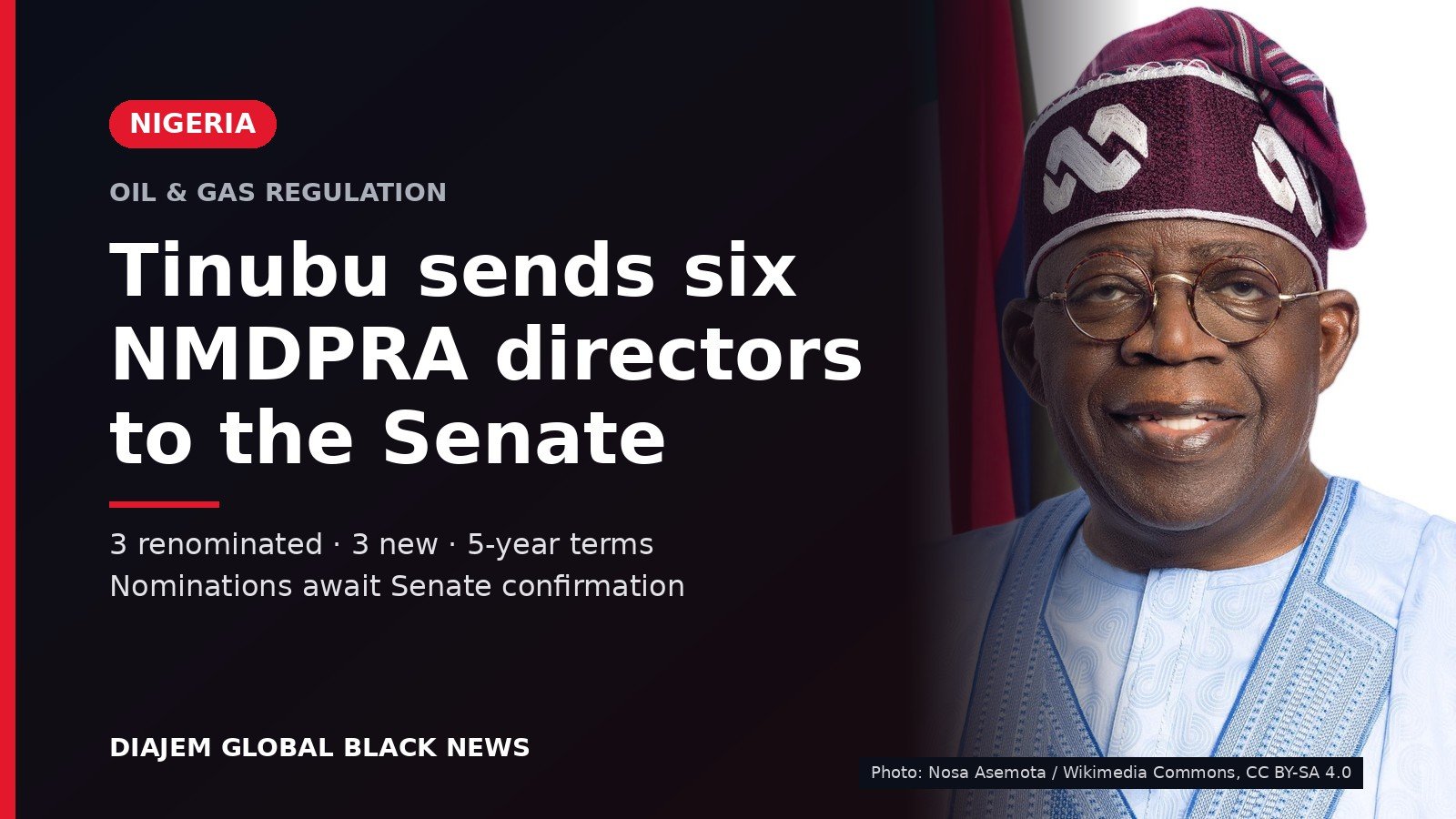
President Bola Tinubu has asked the Senate to confirm six executive directors for the Nigerian Midstream and Downstream Petroleum Regulatory Authority (NMDPRA), the body that polices fuel supply, storage and pricing across Africa’s most populous nation.
Main image: DGBN graphic. Photo: Nosa Asemota / Wikimedia Commons, CC BY-SA 4.0
The nominations were sent to the upper chamber in a letter from the President and announced on Friday by his Special Adviser on Information and Strategy, Bayo Onanuga.
Three of the nominees are returning for another term and three are new. If confirmed, all six will serve five-year terms.
Who has been nominated
The three executive directors put forward for reappointment are:
- Abiodun Adeniji – Finance and Accounts
- Ogbugo Kalu Ukoha – Distribution Systems, Storage and Retailing Infrastructure
- Dr Mustapha Lamorde – Health, Safety, Environment and Community
The three new nominees are:
- Mobolaji Tajudeen Musa – Hydrocarbon Processing Plants, Installations and Transportation Infrastructure
- Ogechukwu Modie – Economic Regulations and Strategic Planning
- Said Abutalib – Corporate Services and Administration
The President urged senators to treat the nominations quickly so the authority keeps its leadership continuity and strengthens its oversight work.
He also approved Jumoke Gafar as Secretary to the Board and Legal Adviser of the authority, subject to the statutory process set out in Section 46 of the Petroleum Industry Act (PIA).
A regulator under pressure
The NMDPRA was created under the 2021 PIA to regulate everything that happens to petroleum products after they leave the oilfield, from refining and import permits to depot storage and filling-station standards. Its decisions shape what Nigerians pay at the pump.
The authority’s leadership has changed this year. In April, Tinubu named Engr. Rabiu Abdullahi Umar as chief executive. The new executive team, once confirmed, will work under him at a time when the regulator faces close scrutiny over fuel import licences, the rise of local refining and supply stability. Business groups have, for example, urged the NMDPRA to tie petrol imports to verified supply gaps.
What happens next
The Senate will screen the nominees before a confirmation vote. For ordinary Nigerians, and for the diaspora families who send money home to cover rising living costs, a stable and credible fuel regulator matters: petrol prices feed directly into transport fares, food prices and the cost of running a business.