
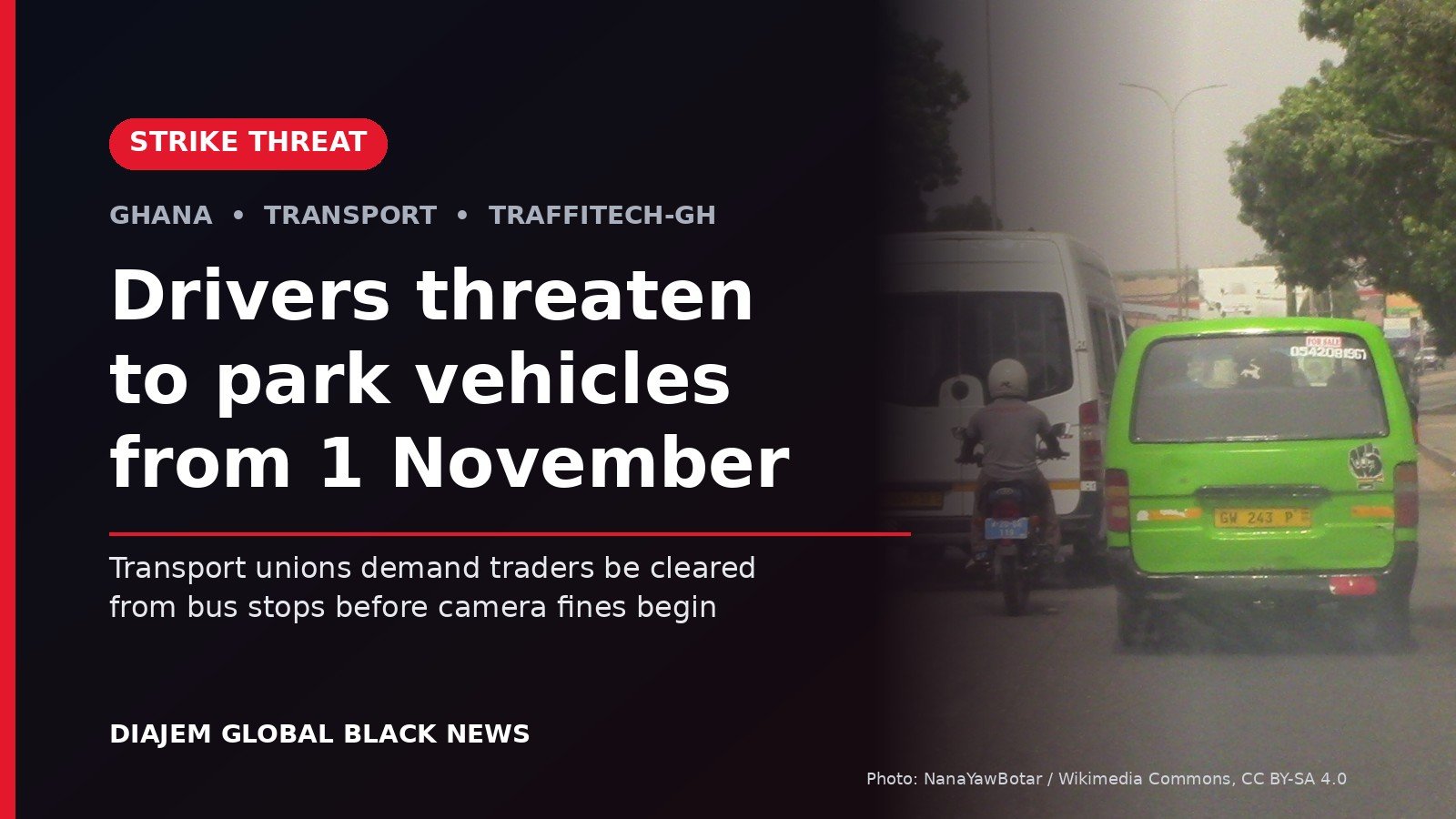
Ghana’s commercial drivers are threatening to pull their vehicles off the roads nationwide from Sunday, the very day the government’s new Traffitech-GH camera enforcement system is due to switch on.
Main image: DGBN graphic. Photo: NanaYawBotar / Wikimedia Commons, CC BY-SA 4.0
In a statement dated Saturday 31 October, a coalition calling itself the Joint Transport Front said drivers would be told to park their vehicles from 1 November unless the authorities first clear traders from bus stops and pedestrian walkways.
The front brings together the Ghana Private Road Transport Union (GPRTU) of the TUC, the Commercial Transport Operators of Ghana and the Concerned Drivers Association of Ghana.
“You cannot digitalise illegality”
Traffitech-GH is a camera-based system designed to catch traffic offences and issue fines automatically. The government has presented it as a road-safety measure aimed at cutting crashes and deaths.
The operators do not reject enforcement outright. Their complaint is that drivers will be penalised for stopping in the wrong places while the spaces set aside for them are occupied by traders. They named busy hubs including Kaneshie, Circle, Madina, Kasoa and Kejetia.
“We will not operate under an unfair and unjust system. You cannot digitalise illegality,” the groups said, adding that the government would be “fully responsible for any inconvenience” the action causes.
In a separate statement, the front went further, accusing the government of wanting to use Traffitech-GH “to extort money from innocent drivers while leaving traders to take over our legally designated spaces”.
A deadline that came and went
The dispute has been building for weeks. The operators first raised the issue at a joint press conference on 13 October and set a 20 October deadline for bus stops to be cleared. They say that deadline passed without action.
The statement was signed by leaders including Samuel Amoah, Asonaba Nana Owiredu, Paa Willie, David Agboado and Yaw Barimah.
At the time of writing, the government, the Ministry of Local Government and the Ghana Police Service had not publicly responded to the strike threat, according to MyJoyOnline. DGBN will update this story when they do.
Why it matters
Tro-tros and taxis are the backbone of daily life in Ghana’s cities, moving workers, traders and schoolchildren. Even a one-day stoppage would hit markets and household budgets, coming weeks after transport fares rose 8% nationwide.
The standoff also captures a wider African dilemma. Governments from Accra to Lagos and Nairobi are turning to digital tools to bring order to crowded roads, but operators argue that technology cannot fix enforcement gaps on the ground. How Accra handles the next 24 hours will be watched closely across the region.